Chief Ahiga
The Outsider (Stephen King Edition)Chief Ahiga, who later took the name Thomas Higgins, connects Marysville’s commercial history and the discovery of the Marysville Hole to the cave’s later role in the investigation. A Navajo chief who moved through places where he was treated very differently, he became a business owner and the cave’s first tour operator. His likeness survives both in the cave’s history and in the small toys left at a memorial to the Jamieson twins, joining a life that began long before the present-day case to its unresolved losses.
Identity and Background
An 1888 photograph shown by Holly Gibney depicts Chief Ahiga in profile, wearing a headdress that falls halfway down his back. Holly recounts that he lived for a time with a small group of Navajos on the Tigua reservation near El Paso. After marrying a white woman, he moved first to Austin, where he was treated badly, and then to Marysville, where he was accepted into the community after cutting his hair and professing his Christian faith. His movements trace a change in outward presentation as well as geography, while the contrast between his reception in Austin and Marysville remains part of the account of his life.
From the Trading Post to the Cave
Chief Ahiga’s wife had some money, and the two opened the Marysville Trading Post. That business eventually became the Indian Motel and Café, the establishment where Ralph Anderson and Holly are staying during their investigation. Its modest present-day appearance makes the connection between the old photographs and the shabby motel room immediate: the business is not merely a place for the investigators to sleep, but a surviving link to Ahiga’s family and place in Marysville.
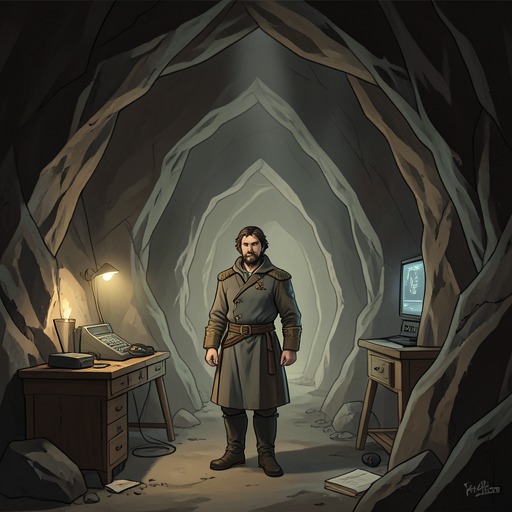
He also ran Marysville’s only successful business and discovered the Marysville Hole, then organized its first tours, which became popular. The cave bears the town’s name rather than his, a distinction Ralph associates with the limits of the community’s acceptance of him. Yet the cave retains a more direct memorial to Ahiga in its geography: the Ahiga entrance, a less prominent access point connected to the Chamber of Sound.
The Ahiga Entrance and the Rescue Route
The Ahiga entrance served as a route for staff bringing supplies into the cave and as an emergency way out. Holly explains that rescue parties entered there in hopes of finding an alternate route to the children. The distinction between the cave’s two entrances matters: the main entrance had been not only boarded up but sealed with cement after children were lost, while the Ahiga entrance had been boarded up without any reported cement seal. The old service passage thus remained a potential way back into the cave when the main route was closed.
Memory and Narrative Significance
The cave’s history returns through objects as well as names. Near a bend in the path, Ralph and Holly find a natural hollow in the rock marked with fading words, “WE WILL NEVER FORGET.” A dusty vase holds bare, branchlike stems, and half a dozen small plastic Chief Ahiga figures lie scattered at its base. They resemble the toy one of the Jamieson twins dropped before the twins crawled into the cave and were never found. The figures are old and sun-cracked, but visitors have left the memorial untouched even though children have spray-painted nearby tags.
Ahiga’s presence in the cave therefore carries more than local historical interest. His name identifies a practical route into and out of a dangerous space; his likeness connects that route to the lost children and to the community’s continuing remembrance of them. The contrast between the celebrated tours he once ran and the later closure of the cave sharpens the reversal: a place once opened to visitors became a site of disappearance, restricted access, and rescue. Through Ahiga, the investigators encounter a past built into the cave itself, in its name, its surviving entrance, and the toys that mark an absence the town has not forgotten.